

What Is a Sound Bath? A Beginner's Complete Guide
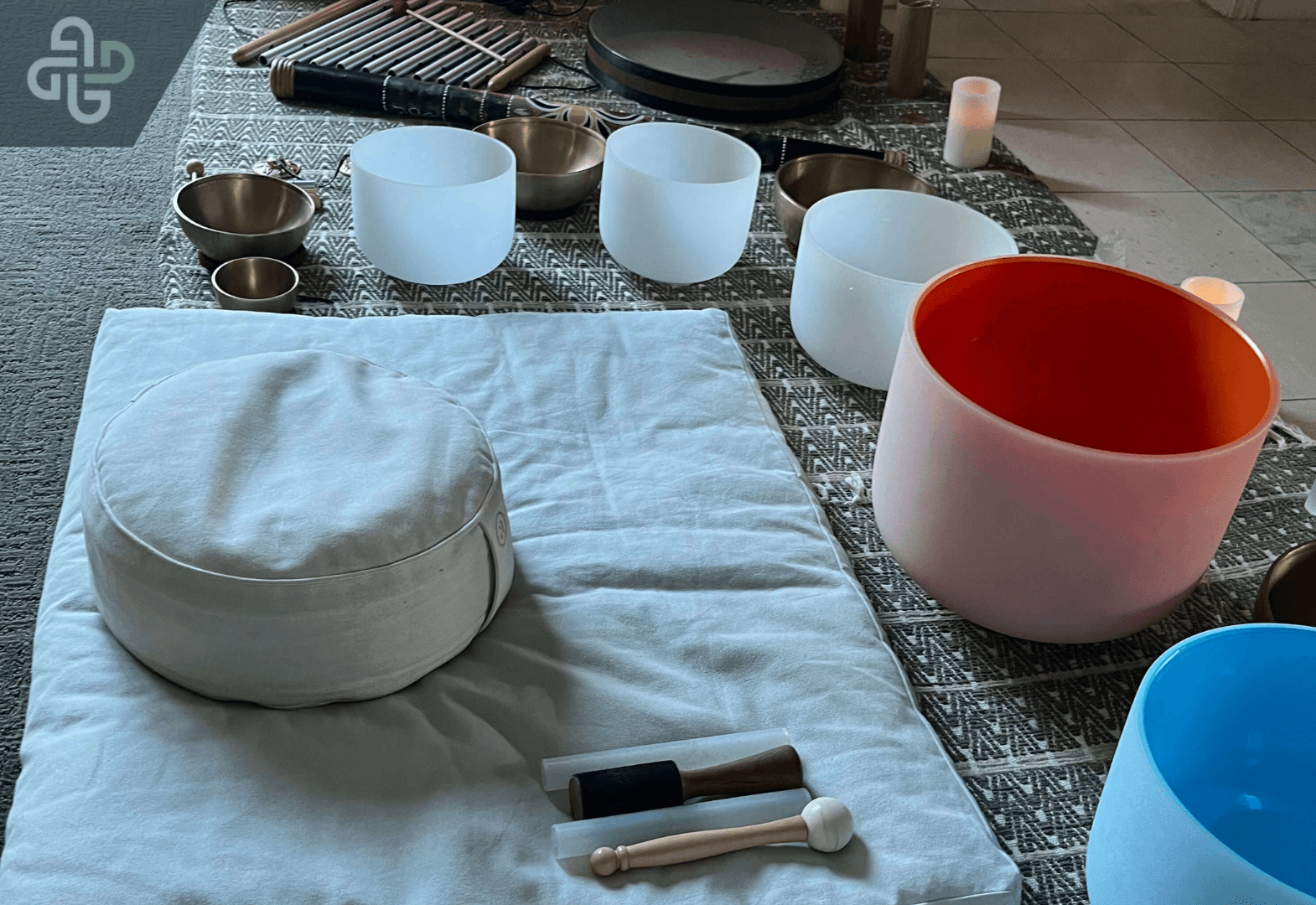
If you’ve been asking what a sound bath is, the easiest way to picture it is this: you get comfortable, close your eyes, and let sound do most of the work.
There is no pose to master. No pressure to “clear your mind.” No need to know anything before you walk in.
That is part of why sound baths appeal to so many beginners. They feel accessible. You do not have to be good at meditation to show up for one. At The DEN, sound baths are described as spaces to slow down, soften, and let the nervous system exhale, which is probably why so many people try them before they try other wellness practices.
What is a sound bath?
A sound bath is a meditative listening experience. A facilitator plays instruments that create long, layered tones while participants rest quietly. Common instruments include crystal singing bowls, gongs, chimes, and other resonant tools that fill the room with waves of sound.
The word “bath” throws some people off at first. There is no water involved. The idea is that you are being bathed in sound rather than doing something active. You are receiving the experience, not performing it.
That is also why people often describe it as easier than traditional meditation. Instead of trying to focus on the breath in silence, you are given something to follow. The sound becomes the anchor. For a lot of people, that makes it easier to settle.
How does a sound bath work?
Most sound baths are simple from the outside.
You arrive, get comfortable on a mat or cushion, and the facilitator begins to play. The room usually gets very quiet, apart from the instruments. Some people drift into a deeply restful state. Some stay aware the whole time. Some notice thoughts at first, then gradually drop into the sound. All of that is normal.
What matters is not doing it perfectly. It is letting your body slow down enough to receive the experience.
There is some early research behind why sound-based meditation may feel calming. A 2016 study on singing bowl sound meditation found that participants reported less tension, anger, fatigue, and depressed mood after the session. At the same time, broader reviews of singing bowls note that the evidence is still limited and not strong enough to treat sound baths as medical care. That is the most honest way to frame it: many people find them deeply relaxing, but they are still a wellness practice, not a cure.
Sound bath benefits
This is the part people usually want to know first.
What does a sound bath actually do?
The answer depends on the person, but a few themes come up again and again:
it can feel easier to relax than to do silent meditation
it may help the body shift out of a high-stress state
it can create a strong sense of rest, even in people who feel mentally busy
it often gives people a break from screens, noise, and constant input
That lines up with what small studies and reviews have started to explore, though the evidence base is still early. Music-based and sound-based interventions show potential for emotional well-being in some settings, but the science is not settled enough to make big clinical claims.
So it is better to think of sound bath benefits in a grounded way. Not as magic. More as a structured pause that some people find surprisingly effective.
What does a sound bath feel like?
This is where the experience becomes hard to describe in a neat way, because it does not feel exactly the same for everyone.
Some people feel heavy and deeply relaxed. Some feel lighter, almost floaty. Some notice emotion coming up. Some feel calm but alert. Some just feel like they finally stopped bracing for a minute.
And yes, some people mostly think, “That was much easier than I expected.”
You do not need to “get it right.” You do not need to force a spiritual experience. You do not need to feel transformed by the end. Sometimes the effect is subtle. Sometimes it is just that your shoulders drop and your mind gets quieter for a while. That is enough.
What to expect at a sound bath
If it is your first time, the unknown can feel more intimidating than the practice itself. Usually, the session looks something like this:
You arrive and settle onto a mat, blanket, or cushion
The facilitator gives a short intro
You lie down or sit comfortably
The sound begins and carries the session
At the end, there is usually a gentle close and a moment to reorient
That is it.
At The DEN, sound bath experiences show up in a few forms, from private sessions to group and corporate offerings, which is helpful because not everyone wants the same environment. Some people want one-on-one support. Others like the feeling of shared group stillness.
How to prepare for a sound bath
If you are wondering how to prepare for a sound bath, keep it simple.
A few helpful things:
wear comfortable clothes
avoid rushing in at the last second
bring water if the space allows
use a blanket or layers if you tend to get cold
go in without trying to force a certain outcome
That last point matters. People sometimes show up asking, “What am I supposed to feel?” There really is no required feeling. The best approach is openness without pressure.
If you are very sensitive to sound, have a medical condition affected by sound or vibration, or are unsure whether a group sound experience is a good fit for you, it is smart to check with your healthcare provider first. A sound bath is generally approached as a wellness experience, not a medical intervention.
Is sound bath therapy the same as meditation?
People often use terms like sound bath therapy and sound bath meditation interchangeably, but they are not always exactly the same thing.
A sound bath usually sits closer to meditation or guided rest than formal therapy. It may feel therapeutic. It may support relaxation. But that does not automatically make it therapy in the clinical sense.
That distinction is useful because it keeps expectations healthy. A sound bath can be a meaningful practice. It can help you slow down. It can become part of a wider self-care rhythm. It just should not be treated like a replacement for professional mental health or medical care when that care is needed.
A gentle place to start
If you are curious, the easiest next step is simply to try one.
You do not need experience. You do not need a meditation background. You do not even need to know whether you are “the kind of person” who likes sound healing.
You just need a little willingness to lie still and listen.
If that feels like the right next move, you can book a sound bath session, book a group sound bath, or explore sound bath events in Los Angeles. The DEN already frames sound baths as a gentle entry point for people who want rest, connection, and something softer than the usual pace of life.
Conclusion
So, what is a sound bath?
At its simplest, it is time set aside to rest and listen.
That may sound small, but for a lot of people it lands bigger than expected. No pressure to perform. No pressure to talk. Just a room, a body, and sound that gives the mind something softer to hold.
That is part of why beginners tend to like it. It meets people where they are.
FAQ
What does a sound bath feel like?
For many people, it feels deeply restful. Some describe it as calming, heavy, floaty, or emotionally clearing. Others just notice that their mind slows down more easily than it does in silent meditation. There is no single “correct” experience, which is part of what makes it beginner-friendly.
Do you fall asleep during a sound bath?
Yes, some people do. That is pretty common, especially if they are tired or finally feel safe enough to relax. Falling asleep does not mean you did it wrong. Many people drift in and out between wakefulness and rest during a sound bath.
How often should you do a sound bath?
There is no fixed rule. Some people go occasionally when they feel overstimulated or stressed. Others make it part of a weekly or monthly rhythm. It depends on what feels supportive, your schedule, and whether the practice leaves you feeling more grounded afterward.
Is a sound bath safe for everyone?
For most people, it is approached as a gentle wellness practice. But if you are very sensitive to sound, have a condition that may be affected by intense sound or vibration, or are unsure how you will respond, it is wise to check with a healthcare professional first. Research on singing bowls is still limited.
What should I bring to a sound bath?
Usually, just yourself and anything that helps you get comfortable. That may mean warm layers, socks, water, or an eye mask if the venue allows it. The main goal is comfort. The less distracted your body feels, the easier it is to settle into the experience.