

Reiki Therapy for Corporate Events: Why Energy Healing Is Entering the Workplace
A lot of corporate wellness still looks like “add one more thing to your calendar.” Another webinar. Another habit challenge. Another perk that sounds nice, but lands like noise when people are already stretched.
This is why Reiki therapy for corporate events is showing up more often, especially in places like San Francisco and the Bay Area, where performance culture runs hot, and burnout is not theoretical.
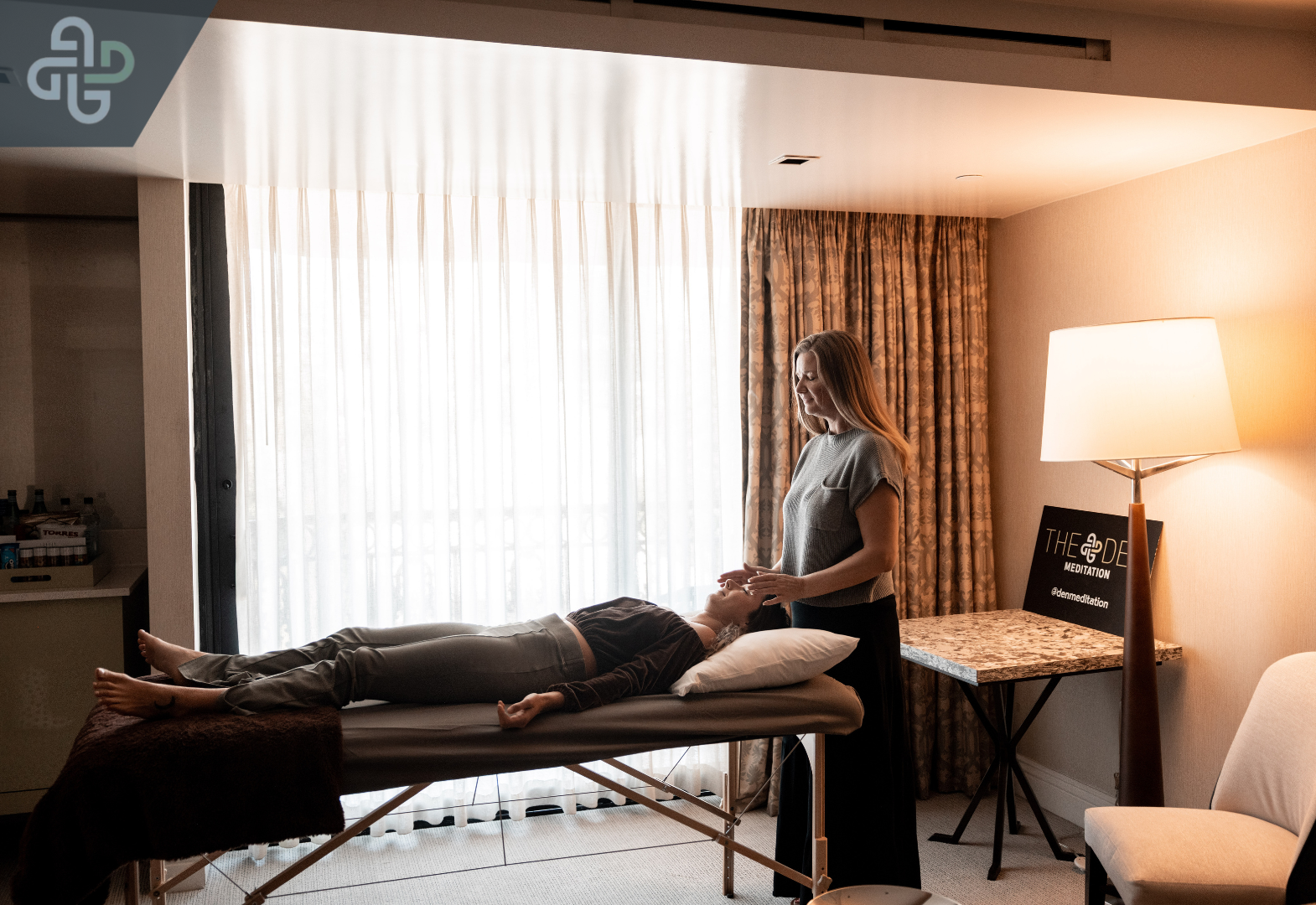
At The DEN Meditation, Reiki is described as a subtle, hands-on or hands-off practice guided with care and presence, designed to feel contained, grounding, and personal. It’s non-invasive and does not involve manipulation, pressure, or force.
What Is Reiki Therapy in a Corporate Setting?
Reiki, as defined by the National Center for Complementary and Integrative Health (NCCIH), is a complementary approach where practitioners place their hands lightly on or just above a person, with the goal of directing energy and supporting the person’s own healing response.
In a corporate setting, Reiki is simply that same gentle practice, translated into a workplace-friendly experience. Think of it as a structured pause that feels human, not performative.
At The DEN, Reiki is framed as a calm, intentional session that supports rest and balance, guided by intention rather than expectation, with practitioners attentive to pace and comfort throughout.
Why Corporate Wellness Is Expanding Beyond Traditional Perks
People are not just tired. They’re carrying uncertainty too.
APA reporting has found workplace stress remains high, with 77% of workers reporting work-related stress in the last month (in its 2023 Work in America survey reporting).
And in APA’s 2025 Work in America survey reporting, 54% of workers said job security has a significant impact on their stress levels.
When that’s the backdrop, the old perks can start to feel out of sync. You can’t snack your way out of nervous system overload.
This is where more embodied options enter the conversation: meditations, retreats, sound work, and yes, Reiki. The DEN explicitly positions its private and corporate wellness experiences as customizable for individuals, groups, and businesses, including corporate events and retreats.
Benefits of Reiki Therapy for Corporate Events
Let’s keep this honest and grounded.
What the DEN claims their corporate wellness offerings can support includes outcomes like improving focus and concentration, building resiliency and decreasing anxiety, boosting emotional intelligence, improving communication skills, team bonding, and overall workplace happiness.
What the DEN says Reiki is often sought for includes:
deep rest and relaxation
emotional grounding
support during periods of transition or stress
a sense of energetic balance and calm
And if you want the research lens: the evidence based on Reiki is mixed and varies by study quality. NCCIH describes Reiki as a complementary approach and discusses the state of evidence cautiously.
There are also published reviews that suggest potential benefits for anxiety in some contexts, while still noting limitations and variability across studies.
The practical workplace takeaway: many teams choose Reiki because it’s gentle, low-effort for participants, and creates a clear “exhale” moment in the middle of busy days. The DEN also emphasizes that sessions are designed to create conditions for rest, not to force outcomes.
What a Corporate Reiki Session Looks Like
A corporate Reiki session should feel simple, respectful, and easy to receive. Here’s a realistic flow that aligns with how Reiki is generally described (hands lightly on or above the body) and how The DEN describes its Reiki sessions (contained, intention-led, paced to comfort).
Typical structure (workplace-friendly):
Arrival + brief orientation (2–5 minutes): what Reiki is, what it is not, and how to opt out without awkwardness.
Consent and comfort check: hands-on or hands-off preference, any boundaries.
The session (often 10–30 minutes per person): quiet, minimal talking, gentle presence.
A soft close (1–2 minutes): time to sit up slowly, drink water, and transition back.
Optional integration prompt: one sentence employees can take back to their day (“What feels quieter now?”).
The DEN also highlights that Reiki can support the nervous system through stillness and gentle energetic attention, and that many people notice calm during the session and reduced mental noise afterward (with experiences varying).
Reiki vs. Other Workplace Wellness Experiences
| Experience | Best for | What it feels like | Participation style |
|---|---|---|---|
| Reiki | quiet reset, stress-heavy seasons, gentle support | still, personal, grounding | individual or small-group |
| Ceremonial sound bath | group decompression, shared calm | immersive, sensory, collective | group |
| Team building workshop | skills + culture building | engaging, interactive | group |
| Interactive wellness stations | event-style variety, drop-in experiences | flexible, energetic | optional drop-in |
| Custom team retreat | deeper culture shift, reconnection | spacious, immersive | full/half-day+ |
Sometimes the question is not “Is Reiki good?” It’s “Is it the right fit for this team, this moment, this culture?”
Here’s a simple comparison using offerings The DEN lists in its corporate wellness experiences (like ceremonial sound baths, workshops, interactive wellness stations, and custom team retreats), alongside Reiki.
If your team is already overstimulated, Reiki can be a softer entry point. If your team wants a shared experience that builds a collective “we just exhaled” moment, sound baths and retreats can land beautifully.
Reiki Season: Why Demand Peaks at Certain Times of Year
You’ll sometimes hear planners call it Reiki season. Not as an official calendar, but as a pattern: the moments when people are most hungry for calm.
Two common peaks show up again and again:
1) End-of-year pressure (Q4): deadlines, performance reviews, holiday stress, and “wrap it up before we close the books” energy. The APA has reported that many adults experience holiday-season stress, and its reporting highlights how common seasonal stress can be.
2) Early-year reset (Q1): teams come back carrying fatigue, and leaders often want a more intentional tone for the year.
This matches how The DEN describes why people seek Reiki: support during periods of transition or stress, and a one-time reset or part of an ongoing wellness routine.
Hosting Reiki Therapy Events in San Francisco and the Bay Area
If you’re searching for energy healing in San Francisco, Reiki in San Francisco, or Reiki in the Bay Area, you’re not alone. The DEN itself talks about mindfulness demand across California, from “San Francisco’s tech hubs” through the broader state, and it includes a Bay Area presence in its in-person navigation.
For Bay Area companies, the practical considerations tend to be:
Space: quiet conference room, low foot traffic, comfortable seating
Scheduling: staggered sessions so teams can participate without work pile-up
Culture fit: clear framing (stress support, focus, reset) so it doesn’t feel “woo forced”
Accessibility: chairs available, opt-in participation, respectful boundaries
The DEN also positions corporate wellness experiences as fully customizable and curated based on what the organization needs, and invites teams to plan a corporate event with their facilitators.
A Workplace Reset That Feels Personal Again
Reiki at work is not about turning the office into a spiritual retreat. It’s about giving people a genuine pause, the kind that lets them return to their day with less noise in their system.
If you’re exploring Reiki therapy for corporate events (especially during Reiki season, when stress runs high), start with a simple question: Do we want something energizing, or something calming? If the answer is calming, Reiki is worth considering.
To explore The DEN’s Reiki approach, visit here.
FAQ
What is a corporate Reiki therapy session?
A corporate Reiki session brings a gentle, non-invasive energy practice into a workplace setting. Reiki is typically offered with hands lightly on or just above the body, and The DEN describes sessions as intention-led, contained, and paced to each person’s comfort.
What happens during Reiki therapy for corporate events?
Most events include a short orientation, consent and comfort check, then a quiet session time. The DEN notes Reiki is hands-on or hands-off, non-invasive, and designed to create conditions for rest rather than forcing outcomes, so employees can simply receive and reset.
How does Reiki support employees at work?
The DEN explains that Reiki is often chosen for its calming effect on the nervous system, with many people noticing calm during the session and reduced mental noise afterward (experiences vary). More broadly, many workplaces explore wellness supports because stress remains common across employees.
Is Reiki suitable for all employees and workplace cultures?
Reiki is generally offered in an opt-in format so employees can choose what feels right. NCCIH describes Reiki as a complementary approach, and many organizations frame it as a relaxation and reset option rather than a medical intervention. Clear consent and boundaries help it fit diverse teams.
Why do people search “Reiki San Francisco” and “energy healing Bay Area” so often?
The DEN has written about growing workplace mindfulness interest across California, specifically calling out San Francisco and the Bay Area as part of a broader shift toward retreats and meditation programs. That same environment often drives interest in related practices like Reiki as a workplace-friendly reset.